
Skip to content
SCI-01The science, in three minutes

How we turn a formula into evidence you can defend

Watch how species-specific cell testing measures what your product actually does — and why that is the claim a vet or a buyer will take seriously.

Lab4Paws — from formulation to functional data
Ingredient interaction

One ingredient, tested alone, isn't your product

Most claim literature tests one ingredient in isolation. Combine two actives that share a pathway and the effect can cancel out, add up, or multiply — a single-ingredient study can't tell you which one you got in your formulation.

Predicted vs. actual combined effect
Predicted (sum of the two ingredients alone)Actual measured combined effect
AntagonismActual below predicted
AdditiveActual equals predicted
SynergyActual above predicted
General pharmacology exampleCurcumin + piperine

Piperine (from black pepper) slows the metabolism of curcumin and raises its bioavailability by a large margin (Shoba et al., Planta Medica, 1998). Neither ingredient's own literature predicts that shift — it only shows up when the two are measured together.

Testing the finished formulation is the only way to know what your actual combination does — which is what every Lab4Paws panel tests.

CLAIM-04Functional vs medical claims

A functional claim you can prove beats a medical claim you can't

Before you decide what the label says, it helps to know which kind of claim you are making. The two sit under different rules and need very different evidence.

The workable path

Functional claim

What it says
How the product supports a normal body function — and why. Mechanism, not cure.
Example
Supports joint mobility by lowering inflammatory signalling in cartilage cells.
What it needs
Evidence that the mechanism holds for your actual formula. Species-specific canine and feline cell testing gives you that.
Regulatory path
Covered under feed and supplement rules (EU 767/2009 and equivalents). No pre-market clinical trial required.
The regulated path

Medical claim

What it says
The product treats, prevents, or cures a disease.
Example
Treats osteoarthritis.
What it needs
A registered clinical study in the target species, a full data dossier, and a marketing authorisation. In-depth data, time, and cost.
Regulatory path
Veterinary medicine regulation. Without a clinical study you cannot make this claim.

You cannot claim clinical evidence without a clinical study. The strongest alternative is a functional claim that explains the mechanism of action — why the product works, not only that it does. That is what convinces a veterinarian, a buyer, and a pet parent.

THE EVIDENCE LADDER

Three ways to back a health claim (instead of clinical trials)

  1. Level 1: Ingredient literature

    Studies run in humans or rodents, then assumed to apply to dogs and cats.

  2. Level 2: In-vitro on human or generic cells

    Real lab work, but not on the species you sell to.

  3. Level 3: Species-specific canine and feline cell testing

    Your formula, tested on dog and cat cells. This is what Lab4Paws does.

Measure us against the shelf, not against a clinical trial. A clinical trial answers a medical question. This answers whether you can defend the claim to a vet, a buyer, or a pet parent.

Planning a clinical trial? Tell us and we'll show you where cell testing fits first.

TESTING PROTOCOL

How the testing works

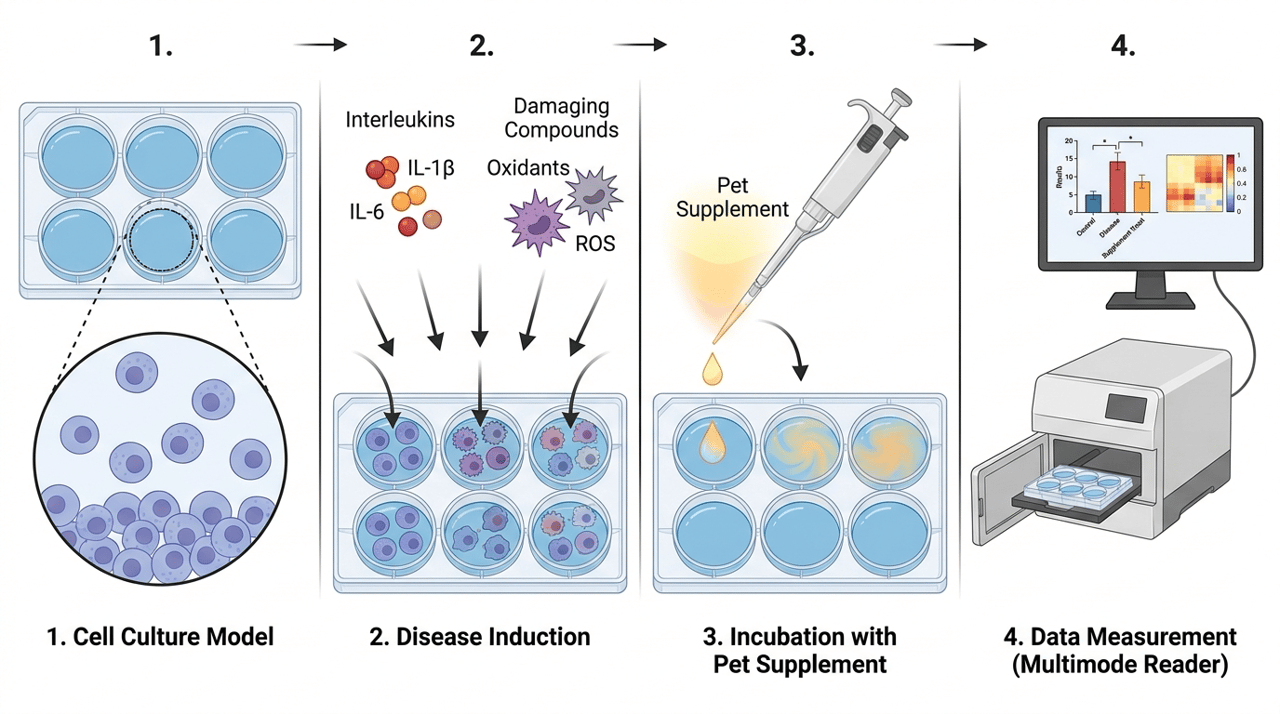
A four-step in-vitro protocol: from canine or feline primary cells to measurable efficacy data.

Four-step testing schematic
WHY LAB-BASED TESTING

Why lab testing - and how it compares to clinical studies.

Your way to proofing health benefit.

The formulation screening advantage

In the lab you test candidates. In a trial you test a finished product. If you want to optimise before you manufacture, the lab is the only option.
Lab lane:
50+ formulations/day, starting from the raw materials
Start months before production
best performer out
optimise, retest, go to production
Clinical lane:
1 finished product , dependent from production
3–6 months trial
pass or fail
if fail: start over

What lab results tell you

If it doesn't work on the cells, it won't work in the animal. A negative lab result kills a bad claim before you invest in it.
Cell-based validation is the required first evidence step - even in the development of pharmaceuticals.
Not all clinical evidence is equal. A controlled trial with measured biomarkers is strong data. A pet parent questionnaire is an anecdote. Both get called "studies." They're not the same.
Planning a clinical trial? Tell us and we'll show you where cell testing fits first.